
How were hats born? How many models and types of hats exist throughout history? And what are the names of the hats we see every day in fashion collections? In this article we answer all questions about the world of hats and their evolution in culture through the centuries.

BOATER: A typical flat-crowned straw hat, commonly known in its Italian and French variants as paglietta or canotier. Its use was often associated with the sport of rowing, as part of the uniform, to the point that it was frequently called the “rower’s hat”.
PILLBOX: Also known as a tambourine hat due to its resemblance to the well-known musical instrument, it is a classic women’s hat, flat and brimless.
DEERSTALKER: The detective’s hat, made famous by the character of Sherlock Holmes, found almost exclusively in the British countryside as a hunting hat.

COCKTAIL: A small, extravagant women’s daytime headpiece, worn for official occasions as an alternative to the wide-brim hat. It is usually decorated with feathers, bows and veils.
COWBOY: A hat associated with American cowboy attire, featuring a centre-dented crown and a wide brim turned up at the sides. The concept of a wide-brimmed hat for riding comes primarily from the tradition of Mexican vaqueros. It is considered particularly functional as its width can protect from both sun and rain, and is still used in working contexts today.
TRILBY: Originally designed for women — it takes its name from the protagonist of a late nineteenth-century stage comedy who, at the premiere of her show, wore a hat of this style. The trilby has a shorter, narrower and more angled crown than the fedora. From the 1920s onwards it became extremely popular among men as well. It was widely worn in the 1960s for a practical reason: car roofs were low and space was limited, so hats needed to be smaller too. It is effectively a unisex hat.
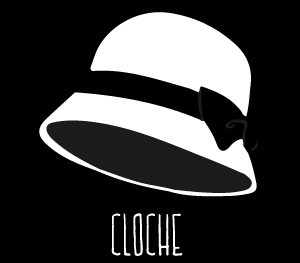
CLOCHE: A bell-shaped women’s hat from which it takes its name, associated with 1920s and 1930s fashion, the period of its greatest popularity. Purchased by the Empress of Austria in Vienna and the Grand Duchess of Tuscany, the earliest examples were made of straw. The Museum of Straw and Weaving in Signa (Florence) preserves an extremely rare cloche — datable to the late nineteenth century and known as the Cappello della Sovrana — crafted from a braid of the finest straw.
TRAPPER: The fur hat, known in Russian as ušanka (ушанка). It is a headpiece of Russian origin, primarily used by the military but also widespread among civilians. Covered in fur, it has a cylindrical shape with long side flaps to keep the head and ears warm.

FEDORA: A soft felt winter hat with an indented lengthwise crown. It has a truncated cone-shaped dome, pinched at the front on both sides, with a medium-width brim. The term fedora came into use from 1891, deriving from the title of an 1882 screenplay by Victorien Sardou written for Sarah Bernhardt, who played Princess Fedora wearing a hat of exactly this shape. It is also informally known as a Borsalino, though in reality this is the registered name and trademark of the Italian clothing company Borsalino, which deserves great credit for making this hat model famous worldwide. It became iconic for being regularly worn by celebrated figures such as Al Capone, Federico Fellini, François Mitterrand, Humphrey Bogart, Harrison Ford, and John Belushi in the film Blues Brothers.
BASEBALL: Often associated with the sport from which it takes its name, it is a casual cotton fabric hat with a large curved or flat visor and a round crown. Baseball caps frequently feature an elastic or velcro fastening at the back to adjust the fit. The current style was popularised by player Babe Ruth of the New York Yankees in the late 1920s.

BERET: Commonly known as a basco in Italian, it is a cloth headpiece with no brim or visor, usually made of knitted wool or felt. Initially used in a military context, it later spread successfully as a casual accessory. The beret became popular among the peasants of the Basque Country, the region from which it takes its Italian name and where it is the traditional national headwear.
BEANIE: The simplest and most practical winter headwear. Made in wool, cashmere or other fibres, it keeps the head warm by covering it completely. Also known as zuccotto, not to be confused with the zucchetto, which instead identifies the skullcap worn by the Pope (white), Cardinals (purple) and Bishops (violet).

PANAMA: Originating from Ecuador, it is traditionally hand-woven using fibres from the young leaves of a dwarf palm known in Spanish as palma toquilla. This hat bears the name of Panama City solely because it was the main trading hub for the hat for centuries. Depending on quality, the weaving process can take anywhere from one day to eight months. In 2012, the traditional weaving of the Panama hat was recognised as part of Ecuador’s Intangible Cultural Heritage of Humanity.
TOQUE: The word toque — literally meaning “touch” — refers to a type of beret, deriving from the long wigs worn by Spanish and French nobles from the 15th century onwards. Over time the term came to denote caps associated with a specific rank, title or profession: for example the judge’s cap, the academic cap, or the toque blanche — the chef’s hat. Today the term has come to refer to the modern winter slouchy beanie, handmade in wool or synthetic fibres, whose main purpose is protection from the cold.

BOWLER: The classic bowler hat is a hard, rounded felt hat. In the USA it is called a derby hat, a name derived from Count Edward George Derby who wore it. The bowler has been worn by many actors who made it a defining feature of their characters — most notably Charlie Chaplin.
FASCINATOR: A cross between a small hat and a hair headband. Considered the most fashionable and eccentric bon ton headpiece, it is often decorated with fabric flowers, veils and feathers.


BUCKET: A hat made of waterproof fabric, commonly known as a fisherman’s hat.
NEWSBOY CAP: A casual hat born in North America at the end of the 19th century, made of soft wool with a rigid visor. The crown is made up of panels finished at the top with a button. The style was popular in Europe and North America from the late 19th to the early 20th century among boys and adult men. As the name suggests, it is a model commonly associated with newsboys and journalists.
KIPPAH: The kippah is the headpiece worn by observant Jewish men, mandatory in places of worship, though the most devout wear it throughout daily life. It is the custom of observant Jews to keep their head covered as a sign of respect towards God, and any suitable headwear may be used for this purpose.

Hats are essentially head coverings worn for many different reasons: fashion, sun protection, ceremonies or rituals, and they have often differed between women and men. The first depiction of a human wearing a headpiece dates back 15,000 years: engravings in a cave at Lussac-les-Châteaux (France) serve as testimony. At that time it was a tool of defence against dangers such as falling stones or branches.
Over time, the headpiece became a symbol. A clear example is the pileo, which for the ancient Greeks (as well as in ancient Illyria, Etruria and Pannonia) indicated membership of the lower classes: made of felt or leather, it was worn by workers, fishermen and sailors (even Ulysses, the celebrated figure of mythology, was depicted wearing the pileo). In ancient Rome, however, it was a symbol of freedom: it was given to slaves when they were granted their liberty. This is why Phrygian caps were known as “caps of liberty” when worn during the French Revolution.

The first hat with a brim was also of Greek origin: the petasus, which provided shelter from the sun. Typically worn by farmers and travellers, it was also the headwear of heroes such as Theseus and Perseus and, with the addition of wings, of the celestial messenger Hermes (Mercury).
Throughout the Middle Ages and beyond, the hood was used instead — often simply a scarf or a flap of a cloak placed over the head. Around the mid-1400s in Flanders, the hennin appeared: an elongated cone with a veil falling from the tip — fairies and fairy-tale princesses are often depicted wearing this headpiece, which could reach 90 cm in height.
It was a highly fashionable accessory among the upper classes throughout the fifteenth century in the Netherlands, northern France (Burgundy) and parts of England. During the same period, the hat began to spread across Europe through the French kings Louis XI and Charles VIII, who were depicted wearing a variety of precious headpieces.

It was only after 1500 that the hat became a purely decorative accessory, and all kinds were produced: in velvet, silk and beaver fur, enriched with gems, feathers and veils. It is said that in the late 1600s Louis XIV of France, the Sun King, even had a 35-carat diamond set into his headpiece. Only he was permitted to wear a hat at court and at the table — all others were obliged to remove theirs as a sign of respect. Louis XIV also extended the use of the tricorne, previously worn only by soldiers and sailors, lending it to visitors wishing to tour the Palace of Versailles.
By the early 1700s, practically everyone owned a tricorne, widely worn also by women in a smaller version placed atop their wigs. During the French Revolution (1789), soldiers switched to the bicorne or feluca, while rebels wore conical caps with rounded tips — a reinterpretation of the Phrygian cap. Introduced in the first centuries BC by the peoples of Phrygia (Anatolia), it distinguished “barbarians” from the ancient Greeks and became a symbol of freedom and revolution, worn also by Marianne, the iconic figure of the French Revolution.

The Golden Age of Hats: New Styles and Materials
The golden age of the hat is undoubtedly the nineteenth century, when the top hat was invented — embedded in popular imagination as the hat worn by US President Abraham Lincoln. It was the celebrated French magician Comte, in 1814, who first used this model in his performances and pulled a rabbit from it. Since the top hat took up considerable space, a collapsible version was also created — the gibus — which could be flattened using a spring mechanism. These years saw a true explosion of new styles, shapes and materials, especially for women’s hats, adorned with bows, ribbons and feathers, in satin, velvet, cloth, horsehair, lace, fur or straw. The most celebrated were the Gainsborough with its large feathers, and the cabriolet fastened under the chin with a ribbon.

At the beginning of the 1900s we were at the peak of this accessory’s success — no one left the house without a hat. Women’s hats were so large that two people could not walk side by side on the same pavement. For men, the fedora was in fashion (so called because an actress wore it during the show of the same name) — Indiana Jones’s hat, in felt with a crease along the top. The working class instead wore the bowler hat, immortalised by Charlie Chaplin, or the newsboy cap. The modern baseball cap was conceived in 1940, though an ancestor appeared as early as the second half of the 1800s, worn by the players of the Brooklyn Excelsiors in New York.
After World War II things changed and people began going out without a hat — an unthinkable gesture until then. Yet this extraordinary accessory never stopped being worn. Beyond maintaining its original protective function, it is seen everywhere: from the white zucchetto on Pope Francis’s head to a fashion accessory on the heads of cinema stars. The gesture of removing one’s hat has always been a sign of politeness and respect and a cordial form of greeting: a head without a hat expresses the absence of any threat.